Heart Ontario Science Centre Heart: Ontario Science Centre
  • about
  • cast
  • contact
  • feature
  • why
  • pulse
  • links
    Every Centennial Project Magical Imperfection: Documentary on the life and times of Raymond Moriyama Ontario Place For All Save the Science Centre
  • Ontario Science Centre staff on highly suspect OSC closure.

    3 July, 2024

    Kevin von Appen (left) Lesley Lewis (right)

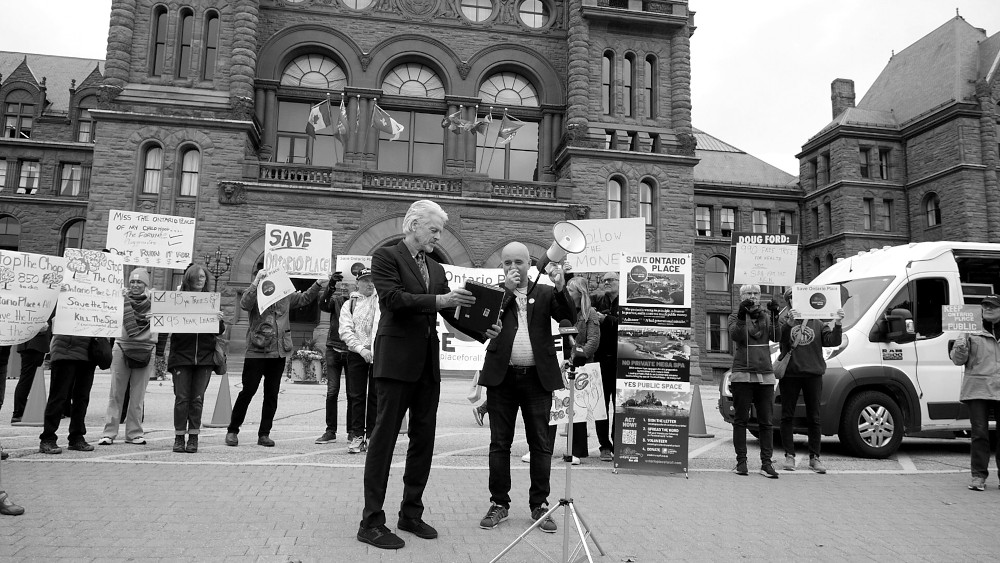
    An interview with Ontario Science Centre (OSC) director of communications, Kevin von Appen and OSC CEO, Lesley Lewis, Ontario Science Centre employees, for The Trill Podcast, on the premature closure of the OSC. The Trill Podcast is short for The Trillium , a news outlet that covers the Ontario government policies at Queens Park. Lewis and von Appen provide scrutinize the OSC closure and the Ford administration's case for the Science Centre / Spa / commercial project.

    Copy excerpt from The Trill: The Ontario Science Centre is no more — at least as Ontarians have known it for the last 55 years. On June 21, the provincial government closed the building, citing an engineering report that said small parts of the roof were unsafe and needed urgent repairs. The government chose to shut everything down rather than try to fix the problems and keep the institution open while a new science centre is built at Ontario Place. And while the province has promised a temporary science centre in the interim, it's expected to be just a fraction of the size of the recently closed facility. Critics, however, haven't drawn the same conclusions from that report. The decision — like almost every move made during the years-long science centre saga — has garnered fierce opposition. Lesley Lewis, who served as the centre's CEO from 1998 to 2014, and Kevin von Appen, who worked for the centre for almost 35 years, including as its director of science communication, join us to walk through the organization's history, slow-percolating troubles that doomed its facility, the current site's future, and its relocation.

    Some key quotes from the episode:

    Kevin von Appen:

    (On keeping the current Ontario Science Centre)...It is better use of public funds, based on the data...as people look at the data, look at the figures...that people will begin to see that the numbers simply don’t add up and it is not the good use of public funds to follow the current course...

    (On the Therme Spa Project)The science centre’s brand is being leveraged to distract from a removal of public accessibility to a public trust, which is the water front...a public trust like a Science Centre, which is what it is, it is much more like a library or a park than it is an amusement that one public trust (Science Centre) is being used in degrading another public trust (waterfront)...

    ...You don’t need to close the building (for repairs)...the nature of the roof panel repairs are that they don’t encompass the entire roof. They are region specific places. Most of the places where the repairs are critical are not even over the actual public exhibition places...

    ...It is common practice, and you can walk up to the Royal Ontario Museum to see it in action now, to complete repairs and maintenance while continuing to run your business...

    It’s past overdue for us to look at places like the Science Centre and say ‘what do we need them to be now, what do we need them to be next’? While honoring all the collective memory and all the collective success of an institution like the Science Centre. There is tremendous scope for something really quite wonderful to happen. I think it could break into a couple of stages. The first stage is the collective realization that the Science Centre, with all the things that needs fixed is head and shoulders the the best option to continue to deliver the civilizational impact of a modern interactive Science Centre that helped invent the field and has innovated throughout. There is a tremendous store of passion and expertise in the Science Centre’s staff. One of the great risks of what’s happening now is there simply won’t be the room and there won’t be the commitment to core creativity which is actually what the Science Centre is really about. It’s more than it’s exhibits it’s more than a great building, it’s about people who can build stuff and think of things that no one else can think of. Within the boundaries of that existing building which is purpose built for exactly that kind of activity there is an opportunity for a tremendous renaissance and I would argue a cost effective one.

    Lesley Lewis quotes:

    ...From what I read in the provincial auditor’s report, it was easier and also we did not experience as many of the serious issues as have emerged which is natural. Buildings get older, you expect the landlord to repair them, the landlord does nothing and then the landlord blames the tenant. Well, that’s just not fair. It wasn’t the Ontario Science Centre that led the building to require these repairs, the landlord didn’t take care of it...

    ...The (engineering report) documents show that you do not have to close the entire building....

    Today we live in a time when science literacy has never been more important and that science literacy I’m not just talking about scientists. We need science literate taxi drivers and poets and we all need basic science literacy and it’s as important today as fundamental literacy and reading and writing. Think about the issues we’re facing, issues of climate change, issues of pandemics, issues of vaccines, we need places like the science centre, we can’t afford not to have a science centre because if we do we are going to exude that knowledge base among the general population.

    • news
    • education
    • architecture
    • Ontario Science Centre
    • Centennial Project


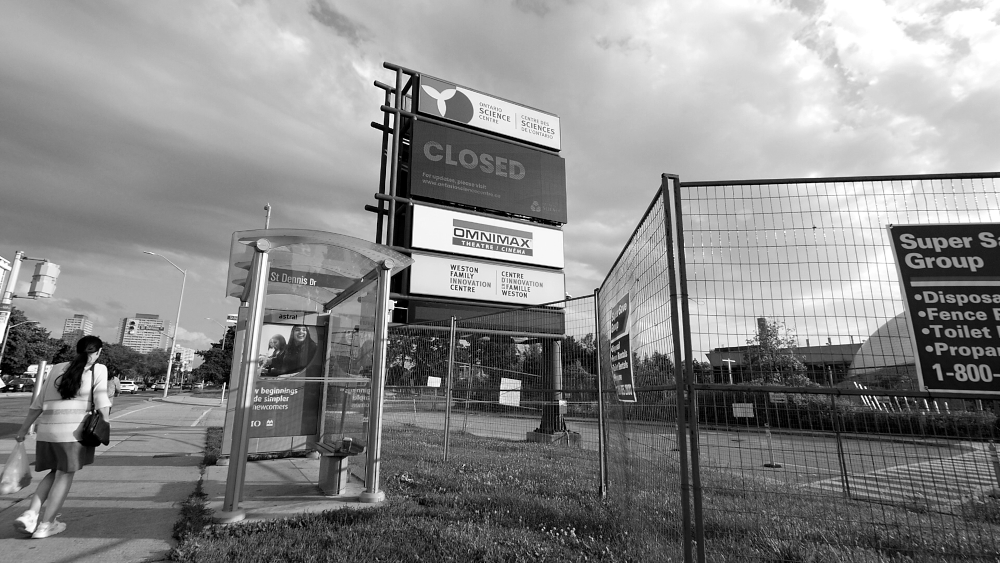
  • Ontario Science Centre, closed...for now.

    21 June, 2024

    Ontario Science Centre digital marquee announces closure

    An abrupt closure of the Ontario Science Centre (OSC) due to concerns that the roof may not be able to withstand upcoming winter snowfall and put attendees lives at risk, ·though it is summer at present. The Ontario government acts preemptively and ceases all operations at the OSC. The structural engineering reports that the current provincial government based their decision off of, can be found here. The OSC was in a state of willful neglect by the government of Ontario for years, and in bad faith, closed down this valued and needed public resource.

    A brief visit was warranted to see what the Ford Administration did to the OSC.

    Here (below) is professor Noam Chomsky to put things in perspective.

    • news
    • education
    • architecture
    • Ontario Science Centre


  • Raymond Moriyama passes, aged 93. Long live Moriyama's works and ideas!

    1 September, 2023

    Moriyama childhood

    (October 11, 1929 – September 1, 2023) Raymond Moriyama passed away, aged 93, on September 1st, 2023 and led a life of both strife and exaltation. Strife from being born Japanese-Canadian and a youth amid the outbreak of World War Two, when he was a child. His family lost their property and business and they, with about 22 000 other Japanese Canadians, were rounded-up and relocated to places like Slocan, BC where Raymond spent part of his youth. Moriyama felt great bitterness from being separated from his mother, socially isolated from his ethnic community due to fifty percent of his skin being burnt from a childhood accident (they called him ‘diseased’) and being denied the same upbringing as non-Japanese citizens. Somehow, Moriyama managed to get past his anger and use the Slocan environs as his place of learning and first forays into architecture. When World War two ended, the Moriyama family started from scratch, relocating to Hamilton Ontario, but Raymond excelled academically and flourished as an architect. From a young age, during the 1950’s, Moriyama was awarded for his designs of golf course shelters dubbed the ‘Half Way House Golf Course’, the Civic Gardens Centre (now called The Toronto Botanical Gardens), and the Japanese Canadian Cultural Centre (JCCC). The latter would lead to Moriyama being selected to design the Ontario Science Centre (OSC).

    Moriyama at Moriyama & Teshima offices

    It was by chance I was asked by the treasurer of the Architecture Conservancy Ontario (ACO) to record an interview with Raymond Moriyama for the 50th anniversary of the OSC. I arrived at the Moriyama & Teshima architecture office at 117 George Street to meet a dapper, elegantly dressed, Raymond Moriyama who was cordial and showed us the conference room. The ACO just needed a ten minute video segment recorded about the OSC, but Moriyama spoke for three hours about the ideation and making of the iconic building and my camera and mics recorded all of it. Moriyama’s work and ideas illuminated areas of my childhood, youth and adulthood. Since an early age, I had school and family trips to the Science Centre and there was always a feeling of being happily overwhelmed at the vastness and beauty and engagement with the science centre. I also attended, however, briefly, Keele Public School, designed by Moriyama. Even children could appreciate it’s unique, almost futuristic, flowing, submarine-like shape. The Toronto Reference Library, another Moriyama building is an ongoing destination since adolescence, is an inspiring paean to knowledge. I always get the cold sweats when looking over the inner space from the top floor balcony.

    Though Moriyama is with us no more, his designs and ideas continue to shape and guide our lives in Ontario. His works are worth struggling to preserve. Below, Moriyama speaks to how Canada is still relatively young country and the golden age, that ‘golden moment’, has yet to arrive.

    • news
    • education
    • architecture
    • Raymond Moriyama


  • Moriyama-designed OAC Centennial Arboretum, Guelph.

    18 August, 2023

    Above, interview excerpt with OAC Arboretum director, Justine Richardson

    Took a trip out to Guelph, Ontario with favoured Toronto-based architecture photographer, Vik Pahwa , to capture the Agriculture College (OAC) Centennial Arboretum designed by Raymond Moriyama. Justine Richardson , director of the OAC Centennial Arboretum, was a superb host who prepared archival images, literature and articles on said building. The building is magnificent, the abundance of windows leads to an immersion in nature hard to find elsewhere except in Moriyama's other works. Would love to see this structure in winter, apparently the building is just as stunning. Construction of the Arboretum was completed in 1974 and as the image denotes below, the land was mostly open and flat. From one perspective of the building, it can almost pass as a glorified garden shed, it seems small. But like Dr. Who's TARDIS, the interior appears far larger than the exterior. That is because a portion of the building is built into the landscape, much like the Earth Homes or Earth Shelter in style during the 1960's. A pop culture variant would be the "Hobbit Homes" from the J. R. R. Tolkein series.

    OAC Centennial Arboretum in 1974

    This contrasts with the current image of the building with attendant foliage, more in keeping with an Earth Shelter. OAC Centennial Arboretum at present

    Vik Pahwa is ideal to have around on an architectural documentation trip, he maintains a surpassing weblog of architectural photography and his work is featured in at least two architecture books, Toronto Architecture: A City Guide, 3rd Edition and Remnants of Mid-Century Toronto. Images of the OAC Arboretum by Pahwa, below.

    Guelph OAC Arboretum by Vik Pahwa Guelph OAC arboretum, another angle by Vik Pahwa

    Stills above by Vik Pahwa

    • photography
    • brutalism
    • architecture
    • Moriyama & Teshima
    • Raymond Moriyama
    • Centennial Project


  • Previous
  • Next